ChatGPT: How AI Technologies Can Be Used in Healthcare



Since its inception in November 2022, the world has been talking about ChatGPT, a new-gen AI language model. It has proved its effectiveness in multiple areas including essay writing, information search, big data analysis, etc. And today, scientists have high expectations about further using it in various industries.
Healthcare is no exception, and in this article, we are going to discover how can ChatGPT be used for healthcare goals, whether are there any pitfalls when applying its features in medicine, and whether are there already cases of use in the healthcare industry which can be an inspiration or, vice versa, an alert for using it.
What Specific Features in ChatGPT Can Come in Handy for the Healthcare Industry
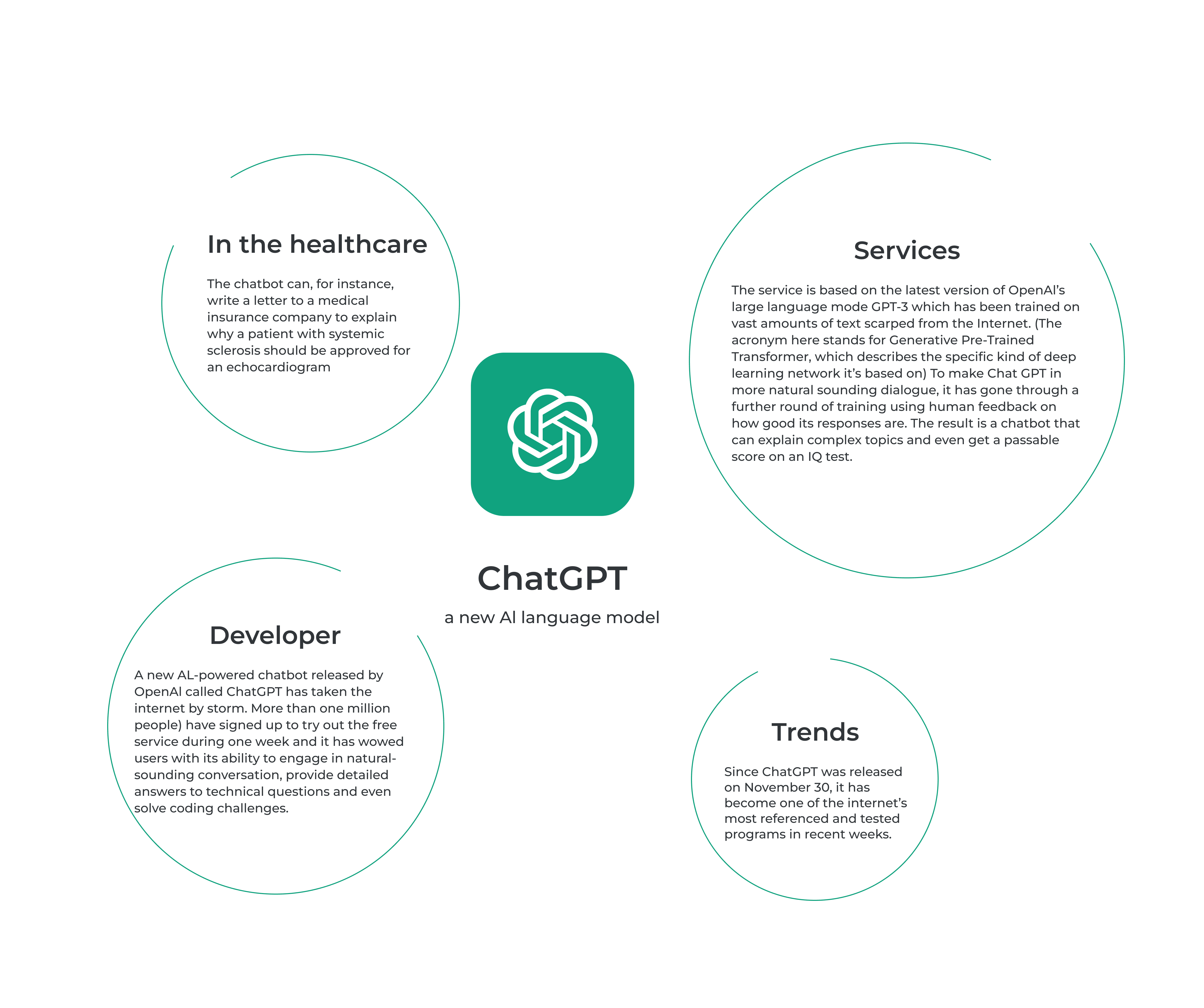
Saying briefly, ChatGPT is a language chatbot based on Artificial Intelligence and machine learning technologies. Its main feature is that it almost perfectly mirrors human talks and conversations. If earlier we used special tools to generate text content, and it was flawed and required making considerable edits in it to make it look like texts written by a human, ChatGPT overcame these flaws, and now it produces content which is truly resembling intuitive human speech. In a text format, of course.
Due to this significant ability, ChatGPT was already taken as an armor by various industries. Essay writing, chatbot conversations, and data analysis were trusted by businesses and individuals with this AI tool. Besides, it’s an inexhaustible source of entertainment for millions of people worldwide!
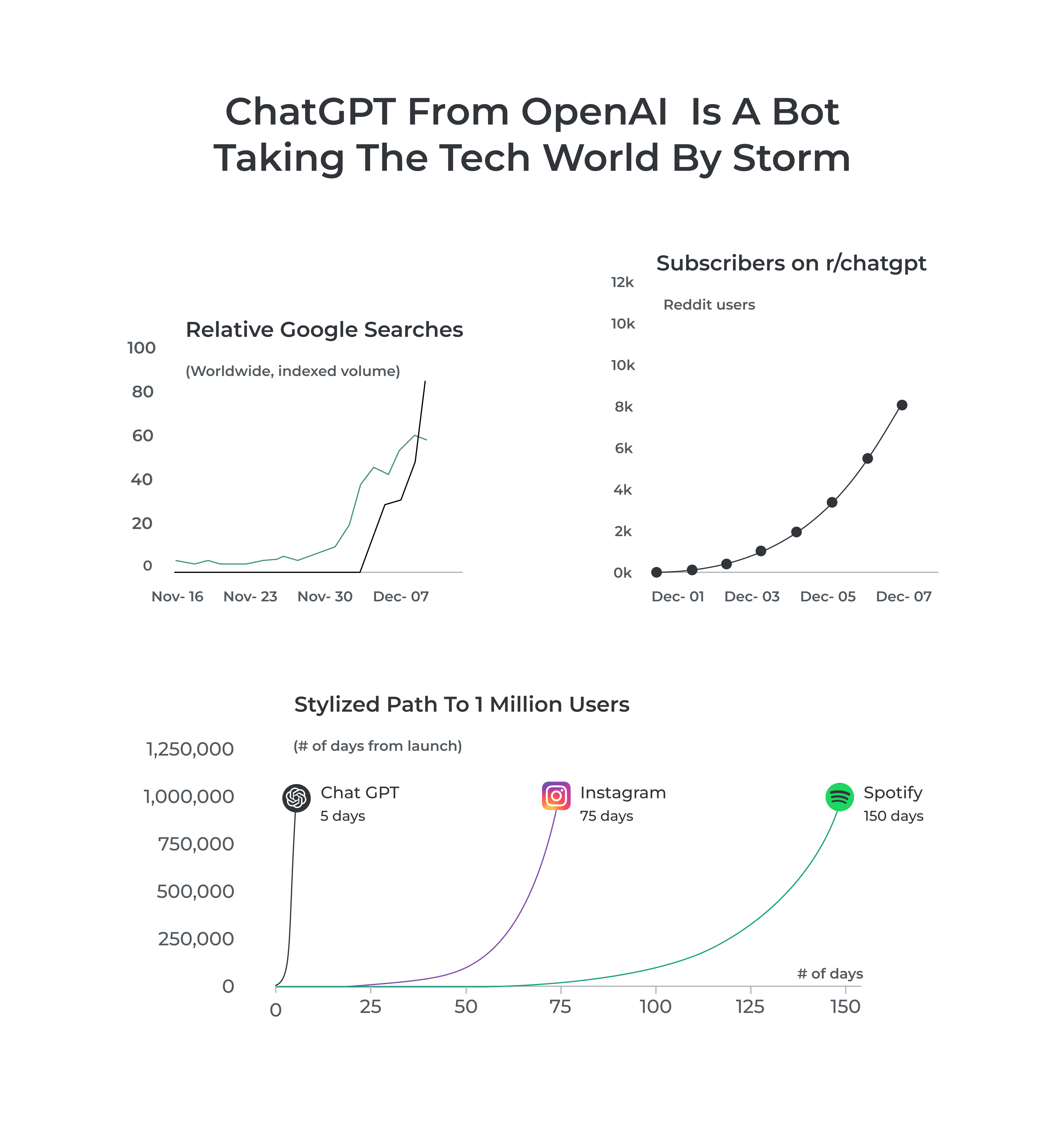
Just keep in mind that ChatGPT’s audience is the largest among all the apps around the world. Just in a couple of months, its audience reached an incredible number of 100 million!
That’s why it is not surprising that ChatGPT’s features were appreciated by the healthcare industry too. Doctors and healthcare managers have evaluated the following features of that AI product:
- It scraps a considerable amount of data which is available throughout the global web. That allows ChatGPT to find relevant answers to users’ questions, particularly, in the field of medicine, pharmaceutics, and cosmetology.
- It generates relevant text responses to the questions. That helps to provide human-like conversations with users that is convenient for clinics and hospitals which provide online applications.
- It genuinely works with documentation, particularly, with medical papers, insurance papers, prescriptions for medications, etc.
These basic features have predetermined the possible application of ChatGPT’s opportunities in the healthcare industry.
Today, there is already a list of cases when ChatGPT can revolutionize or simplify the processes in healthcare.
- Since the start of the COVID-19 pandemic in 2020, telemedicine becomes more and more popular. ChatGPT is a perfect helper for this type of healthcare, as it may be helpful in it as a virtual assistant who may book patients’ appointments, remind them about them, and send automatically generated prescription lists to patients.
- In healthcare insurance. You can use ChatGPT for generating claims for insurance coverage for relevant diagnoses or cases.
- In offline clinics, ChatGPT can be helpful in multiple ways. It can proceed with medical histories and record, analyze, and systematize them. It can also help patients as a regular chatbot. And they can be a doctor’s reminder with their comfortable opportunities to collect, process, and text data.
- You can also use ChatGPT as a pre-diagnostic tool to help patients evaluate their current health condition and make a decision about whether they should visit a doctor and which medical specialist will be helpful for them.
- You should not also discard ChatGPT’s advanced interpreters’ skills. It can help with foreign patients, translate medical documentation using specific terms and special slang, and help with simultaneous interpretation during meetings, conferences, and presentations.
- Using ChatGPT in clinical trials is also prospective as during the period of clinical trials, a huge paperwork and management are required, and you can simply delegate these routines to AI.
- ChatGPT is also considered to be helpful in medical education goals. It can help students to find relevant information, and provide testing or evaluation of their knowledge.
That’s just a superficial look at the opportunities which ChatGPT can offer to healthcare specialists. We are pretty sure that with time, the scope of its implementation will be even wider.
Successful Cases of Using ChatGPT in Healthcare: Does Anyone Use It and How?
Well, what about today? Are there companies which are brave enough to use ChatGPT’s functions for their healthcare businesses? There are already several successful cases which prove that AI is a prominent tool for tomorrow’s medicine.
- As that article proves, David Canes, MD in Lahey Hospital&Medical Center, tested ChatGPT as a helper in medical research and ensured it can cope with small tasks to ease the working process of a doctor.
- Anobel Odisho, MD, MPH from California tried ChatGPT’s resources and claimed them to be useful for repetitive writing tasks like prescription filling, medical history assumption, etc.
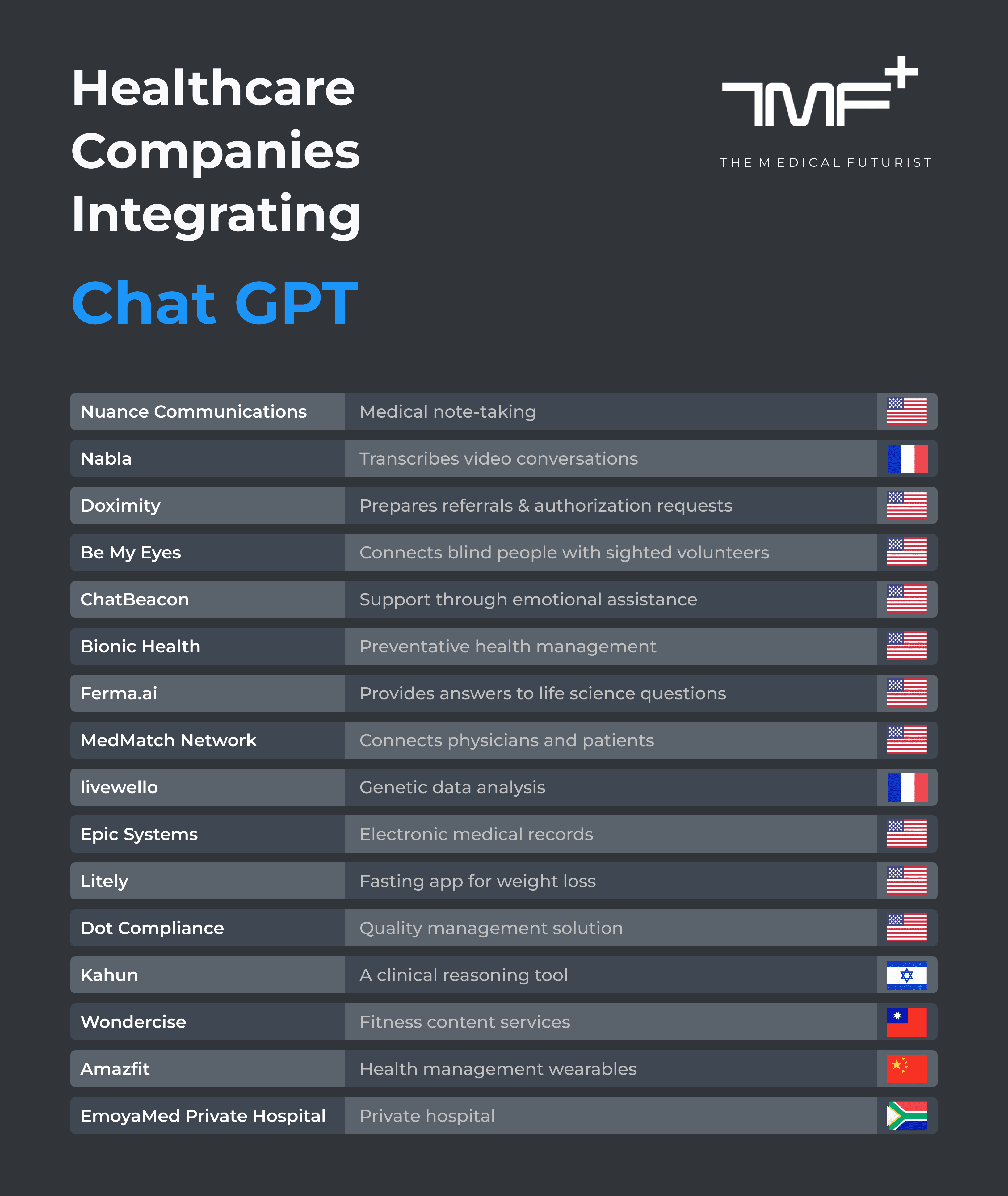
- Nuance Communications is also among the companies that have already integrated ChatGPT as a helper who makes medical notes.
- In Nabla, ChatGPT helps with the interpretation of medical conversations.
More companies evaluated that tool for their healthcare goals, and we’ve prepared an infographic about them for you.
Perspectives and Forecasts: What to Expect in Terms of Healthcare from ChatGPT
Due to the extensive self-improvement of the algorithms used in ChatGPT, its perspectives are bright. It is already obvious that in the future, this AI tool may polish its ability in making precise health evaluations for patients to become a powerful part of telemedicine. Its effectiveness in the development of documentation can also do a good job. Besides, there are lots of still undiscovered features this phenomenon may have. So, we can say that in the future, ChatGPT can get the burden of routine paperwork and preliminary consulting from doctors’ shoulders.
What we should not be afraid of is that ChatGPT will fully substitute medical specialists in the consulting area of their work. Each organism is unique, and using standard and even advanced variable algorithms for their health evaluation and further development of treatment plans won’t work 100%. Thus, it is better to consider ChatGPT as a reliable helper in the healthcare industry, not as its competitor.
Looking to hire developers?